
تعلم اللغة الإنجليزية : 2 – الكتابة الأكاديمية والتفكير النقدي
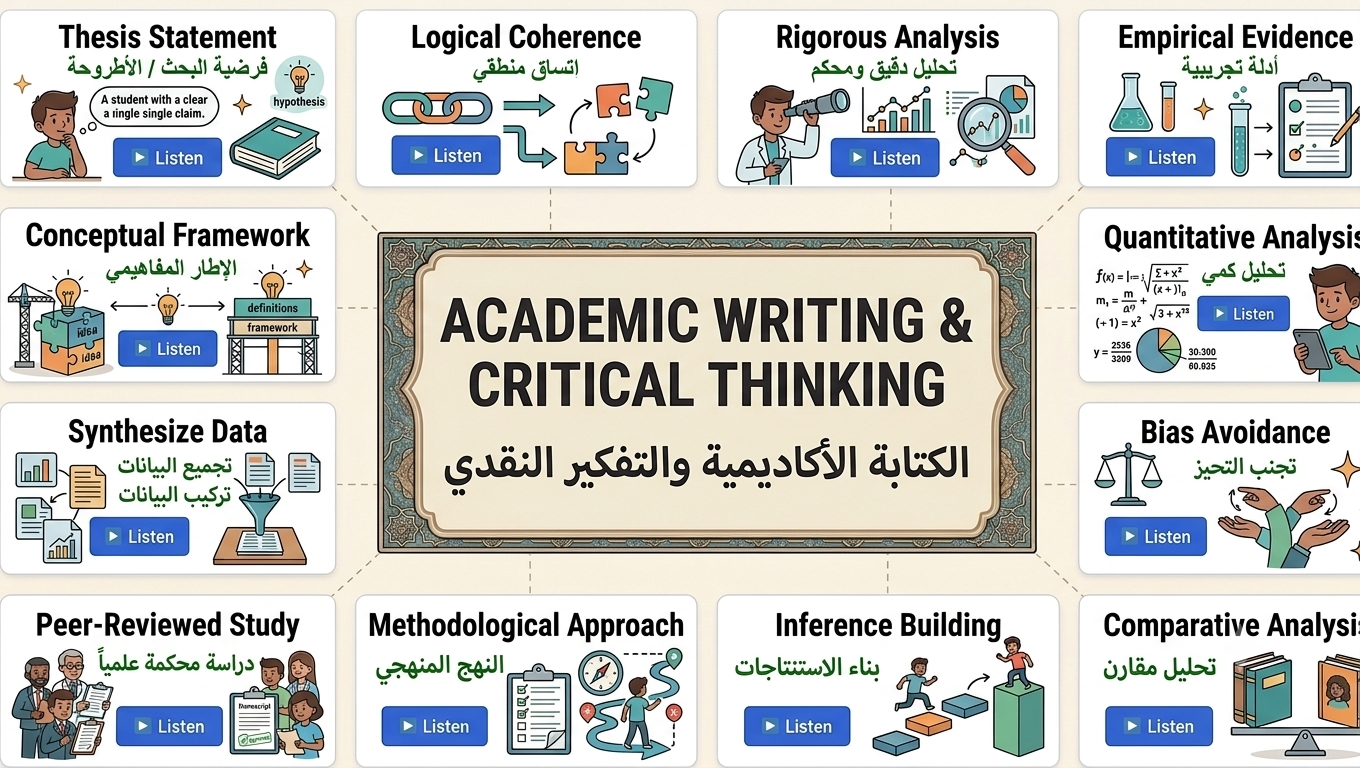
Developing proficiency in academic writing (الكتابة الأكاديمية) and critical thinking (التفكير النقدي) is essential for producing high-quality research papers and formal arguments. To structure a compelling essay, writers must formulate a strong thesis statement (فرضية البحث), analyze complex evidence (الأدلة المعقدة), and maintain logical coherence (الاتساق المنطقي) throughout the document. In this lesson, you will master 15 advanced academic phrases complete with Arabic translations and interactive pronunciation tools.
Essential Concepts in Academic Writing & Critical Thinking
When composing scholarly essays or evaluating research articles, utilizing precise terminology ensures academic credibility:
- Research Design: Scholars establish a conceptual framework (إطار مفاهيمي) and choose a suitable methodological approach (نهج منهجي) whether through qualitative research (بحث نوعي) or quantitative analysis (تحليل كمي).
- Evidence & Argumentation: Authors must gather empirical evidence (أدلة تجريبية) to substantiate claims (إثبات الإدعاءات) while engaging in rigorous analysis (تحليل دقيق) to reach valid conclusions.
- Scholarly Standards: Conducting a comprehensive literature review (مراجعة الدراسات السابقة) and upholding academic integrity (النزاهة الأكاديمية) are mandatory for publishing in any peer-reviewed study (دراسة محكّمة علمياً).
Real-Life Academic Discussion Example
Here is a conversation between a university professor and a postgraduate researcher:
- Professor: How is your dissertation progressing? Have you finalized your thesis statement?
- Student: Yes, Professor. I have built a strong conceptual framework and backed it with empirical evidence.
- Professor: Excellent. Make sure to present a clear comparative analysis in your literature review to maintain logical coherence.
- Student: Absolutely. I am using software to synthesize data and ensure all sources are from peer-reviewed studies.
📝 تمارين تفاعلية | Practice Exercises – Level 3 : Lesson 2
Lesson Conclusion
Congratulations! You have successfully completed Level 3 – Lesson 2.
In this lesson, you mastered key terminology for academic writing and critical thinking. You learned essential expressions such as thesis statement, conceptual framework, methodological approach, empirical evidence, substantiate claims, logical coherence, literature review, and peer-reviewed study.
- Tip of the Day: Academic writing requires objective, evidence-based phrasing—always aim to substantiate claims with empirical evidence rather than subjective assertions!
Exceptional work! See you in Lesson 3.